

Where is Hadzabe tribe located ?
Do the Hadza still exist?
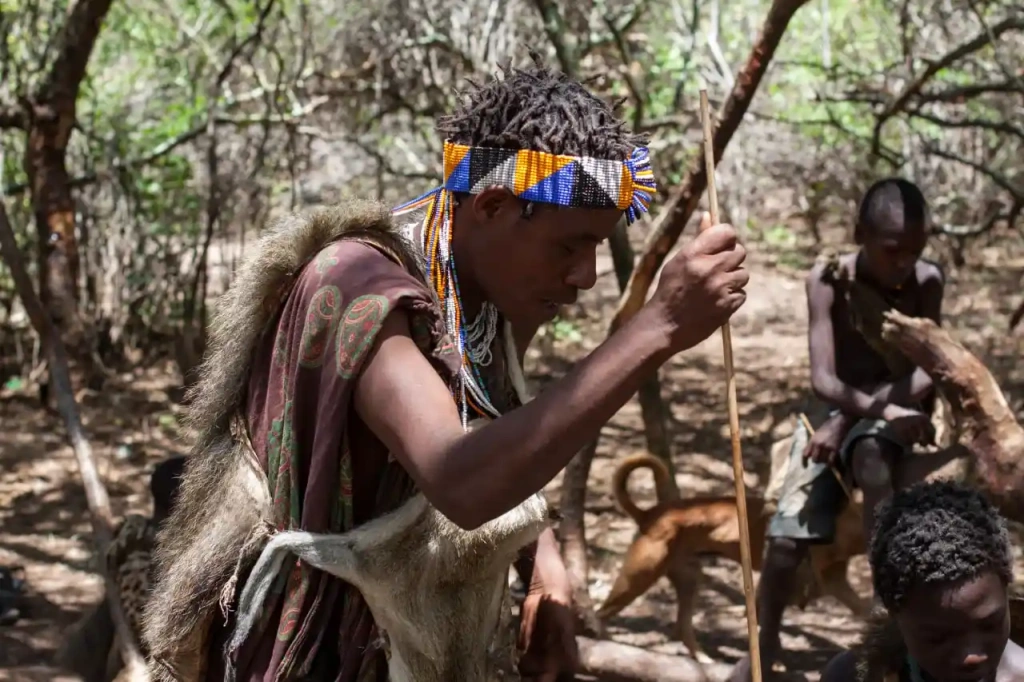
Early morning. Four men are running across the African savannah, tinted pink by the rays of dawn. Bright headbands adorn their heads, animal skins, and trophies from past successful hunts, drape their shoulders. Nearby, small long-legged dogs trot alongside. Both men and animals gaze intently around, trying to spot the slightest movement in the bushes.
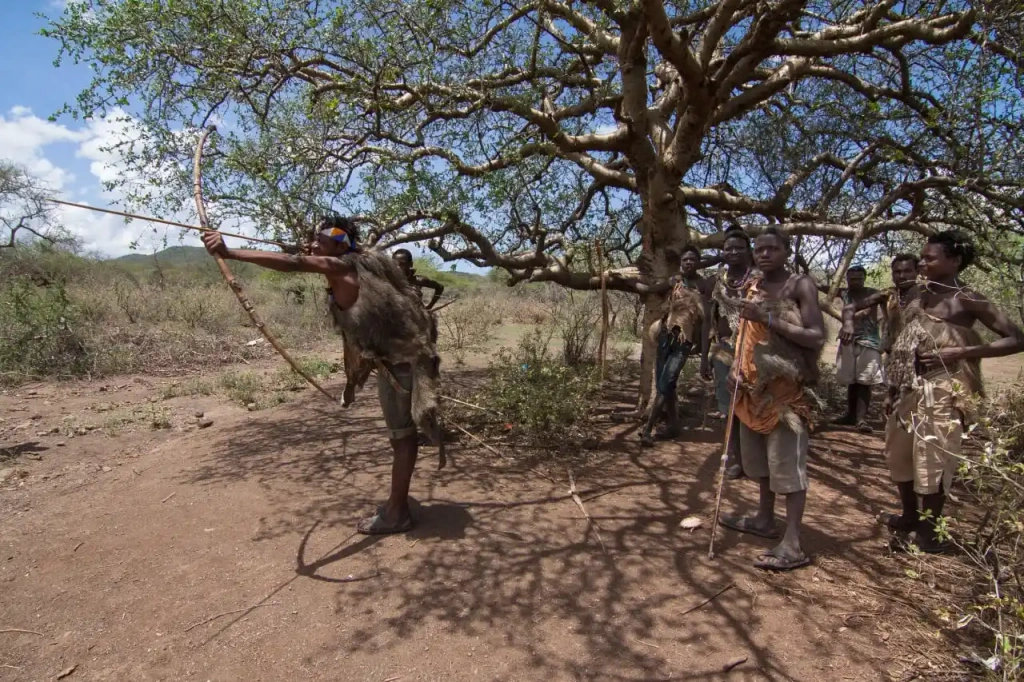
Suddenly, one of the hunters stops, swiftly draws his bowstring, and releases an arrow. It hits its mark—a small bird resembling a parrot. The hunter secures the catch on his belt and continues running.
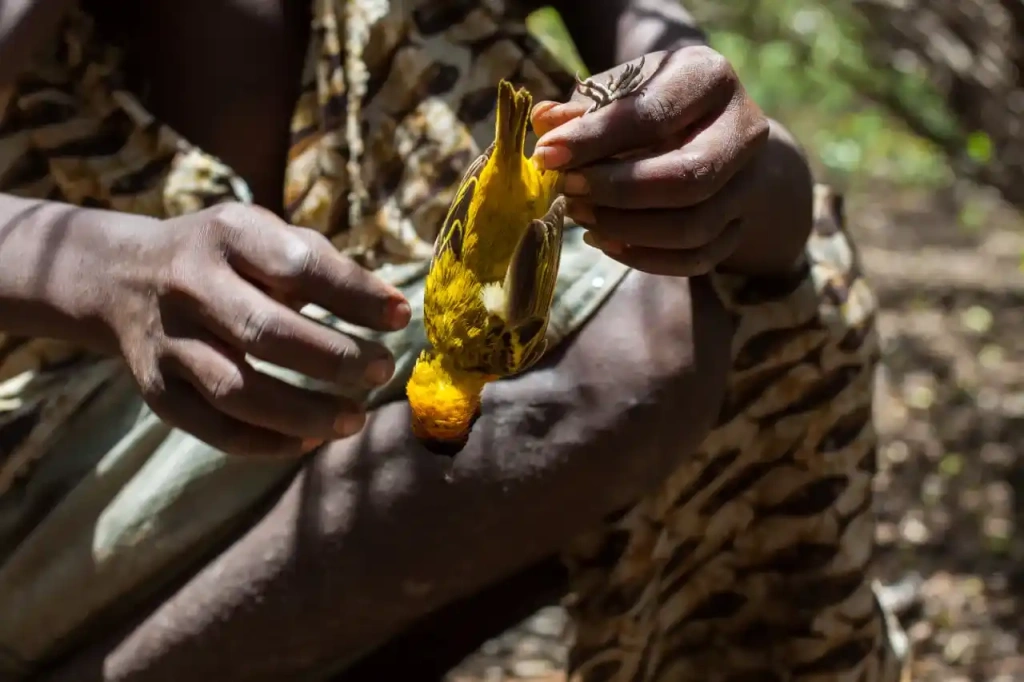
Within half an hour, the Hadza men manage to shoot another bird and a couple of squirrels. Clearly, this is not enough to feed the tribe. They need to track down larger prey.
Suddenly, one of the men notices tracks leading to a pile of large boulders. Someone is hiding there. The hunters call their dogs and command them to investigate the boulders. The agile dogs climb into the crevice and erupt into triumphant barks. The prey is found! With shouts and yells, the hunters drive the quarry out of its hiding place and shoot it down. It’s a white-tailed mongoose, enough meat for both humans and dogs. Today’s hunt can be concluded.
It seems like the described scene took place millennia ago when nomadic hunter-gatherers populated the land. But this is the 21st century, modern Tanzania, the Hadza tribe.
How was the Hadza tribe discovered?
Let’s begin the story of this tribe with the Hadza homeland. The tribe lives in northern Tanzania, near Lake Eyasi. The Hadza were isolated from the rest of the world, thus preserving the way of life and culture of hunter-gatherers.
The first mention of the Hadza tribe dates back to 1897, during the period of the colonial division of Africa by European states. At that time, the territory of modern Tanzania, where the Hadza live, was given to Germany. Therefore, the tribe’s way of life was first studied by German researchers: linguist and anthropologist Otto Dempwolff and geographer Erich Obst. The latter lived with the tribe on Hadza land for several weeks and left a detailed description of their way of life.
In the late 1930s, another German researcher, Ludwig Kohl-Larsen, with the support of the German Research Foundation, embarked on an expedition to East Africa. He was a doctor and an amateur anthropologist who studied primitive peoples. He visited the Hadza territory, collected stories from the Hadza folklore and attempted to put forward anthropological theories.
Kohl-Larsen was a member of the Nazi party and supported its ideas. In his research, he tried to prove that all people have the same origin, but native Africans are inferior to Europeans and therefore still lead a primitive, primitive life
After the end of World War II, Ludwig Kohl-Larsen lost his scientific position. The modern scientific community does not recognize his conclusions.
Active research into the life of the tribe continued in the 1960s. Anthropologists, linguists, geneticists, and scientists from other fields visited the Hadza lands and observed the tribe. They studied their way of life, traditions, social structure, and the unique Hadza language.
What is the Hadza tribe known for?
The Hadza do not have permanent camps and lead a nomadic lifestyle.
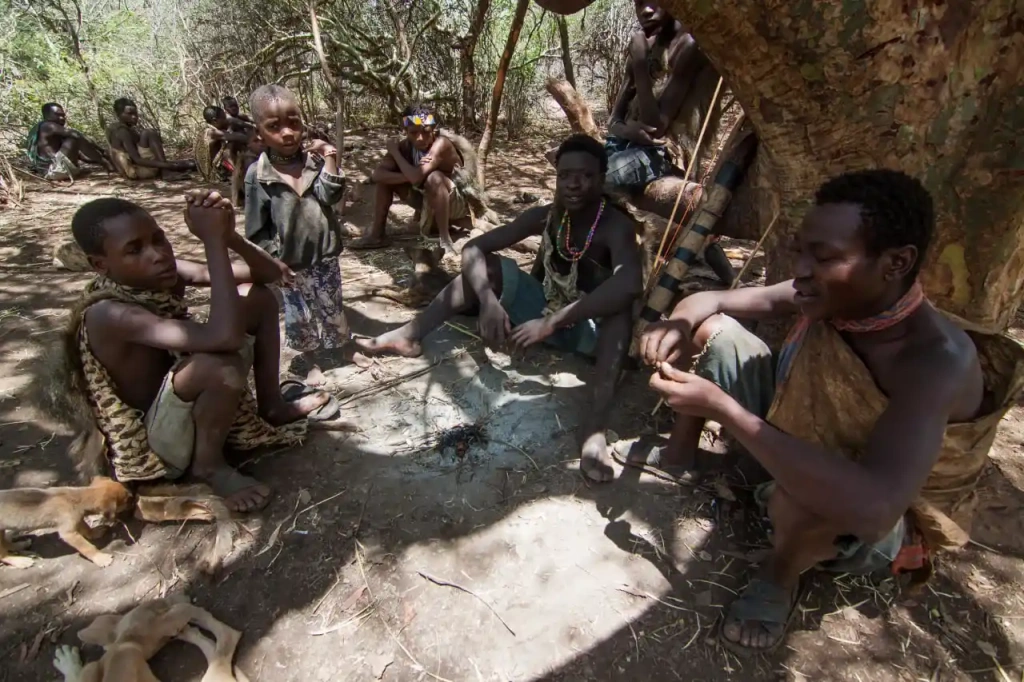
The way of life of the Hadza hasn’t changed much for tens of thousands of years. As of today, the population of the Hadza people is around 1200-1300 individuals. They live in groups of 20-30 people. During long journeys or droughts, they may gather in larger communities of 100-150 people.
Hierarchy in the Hadza society
Within the groups, there is almost no hierarchy in the modern sense of the word. The Hadza respect the elderly members of the tribe and listen to the opinions of the most successful hunter. However, there are no significant status differences. Hadza women and men are equal. In case of a conflict, participants can switch to another group. This, however, makes the groups unstable and often leads to dissolution.
Can you live with the Hadza tribe?

